Spring 2026
From the Board: Recapping the 2026 WOS Hells Gate Annual Conference
By Jon Isacoff

The 2026 WOS Annual Conference based in Lewiston, Idaho was a smashing success, says Jon, who organized the field trips this year. The conference had 139 participants, 30 field trip leaders, and 48 field trips. The participants came from 29 counties in Washington as well as the states of Idaho and Oregon. The field trips turned up a total of 181 species. This included a number of unexpected species, such as Black Swift, White-faced Ibis, Burrowing Owl, Purple Martin and others. The Friday and Saturday night programs were a hit, between the ever popular “stump the chumps” photo quiz and a fascinating talk by Mike Schroeder on the White-tailed Ptarmigan. Read more…
Bonaparte Meadows: A rich and rare place
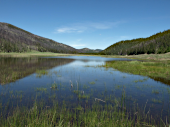
If you are headed to Bonaparte Lake in eastern Okanogan County and pass by a large wetland, you are likely looking at Bonaparte Meadows. This is no ordinary wetland but rather a calcareous fen, among the rarest wetland types in the U.S. It is fed by mineral-rich groundwater flowing through it, which renders it alkaline rather than acidic. This results in diverse and unusual plants and also produces a wide variety and abundance of songbirds. In other words, it’s a great place for birders! Read more…
The Great Egret typhoon in the North Pacific
By Steve Hampton, Andy Bankert and Alex Sowers
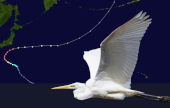
A cyclone that started out near the island of Iwo Jima, Japan last October moved northwest over the warm open ocean, developing into a Category-4 equivalent typhoon. A week later it had reached the Aleutian Islands. The next day it made landfall on Buckland, Northwest Arctic Borough, Alaska, with 100 mph winds severely impacting two Yupik communities. This storm carried with it Great Egrets that came from two different Asian subspecies (alba and modesta). In all, there were dozens of reports. At least two to four individuals continued east and south into British Columbia. And one of them ended up on Washington State’s Skagit River, upstream of Concrete on March 15, 2026, continuing through the spring. It was first found by Cordia Sammeth; Ryan Merrill identified it as an alba subspecies, the first of this taxon for British Columbia and Washington State. Read more …
First documented Female Rufous x Anna’s Hummingbird
By Bill Shelmerdine
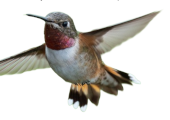
Bill Shelmerdine describes closely observing what he first thought was a female Rufous Hummingbird coming to his kitchen feeder on March 11. After observing and photographing the bird over a couple of visits, he began to have his doubts. He consulted Bill Tweit, and the two of them decided that what they were seeing was a Rufous x Anna’s Hummingbird. Liam Hutcheson stopped by to get some excellent photos, which allowed a deeper dive into identifying the bird. Noted hummingbird expert Sheri Williamson identified it as the first-ever documented adult female Rufous x Anna’s. Read more…
Washington Field Notes December 2024 to February 2025
By Ryan Merrill
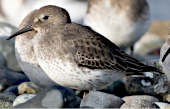
Ryan wraps up Washington sightings for the period from December 2024 to February 2025. Nearly 100 birders contributed notable sightings for this period. Among the reports were an Arctic Loon at the Port Angeles waterfront, a Northern Hawk Owl in Skagit County, a Yellow-bellied Sapsucker in Wahkiakum County, a Brambling in Kitsap County, a Painted Redstart on San Juan Island, and a Great-tailed Grackle at Moses Lake. Hybrids included a Common x Barrow’s Goldeneye and a Bufflehead x Common Goldeneye. Also a Rock Sandpiper x Dunlin seen and photographed in December 2024 at Fort Flagler, Jefferson County, by Ali Kasperzak. It is the first known cross of this hybrid. Read more…
And don’t overlook these other stories in WOSNews Issue #206…
- – A 2025 WOS Conference Recap (Yakima) from our conference partner, Western Field Ornithologists.
- – How Spokane Audubon grew into a more dynamic, collaborative part of its community.
- – A call for applications for the Patrick Sullivan Young Birders Fund award.
- – The formation of a birding club at Washington State University called “Birding at WSU.”